When you click the link, it will take you to the corresponding page.
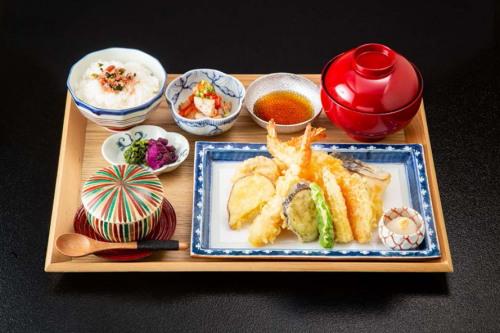
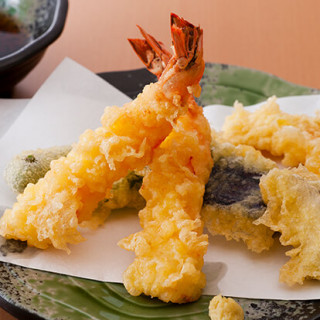
天麩羅膳
Tempura is a dish made by dipping ingredients in a batter of flour, eggs, and water and then frying them. It is one of Japan's representative dishes. The name "tempura" is sometimes added after the name of the ingredient, such as "ebi-tempura" for shrimp tempura, "nasu-tempura" for eggplant tempura, and "chikuwa-tempura" for fish cake tempura. Tempura was originally a commoner's dish sold by street vendors. It is still widely available at supermarket delis and side dish stores and is a popular and approachable dish enjoyed as home cooking. However, specialized tempura restaurants have also increased. Tempura is also used in course dishes at high-end traditional Japanese restaurants called "ryotei," creating an image of a high-end dish. Seafood, vegetables, and mushrooms are the most commonly used ingredients for tempura, but nowadays, various ingredients are used to make tempura, including cheese, soft-boiled eggs, and bananas. When eating tempura, it is usually dipped in "tentsuyu," a soy sauce-based broth, or eaten by dipping it in salt. Some people also put grated radish in tentsuyu 天つゆ, or sprinkle lemon or yuzu juice directly on the tempura, which makes the oily tempura taste cleaner. Depending on the restaurant, the salt used for dipping may be variously flavoured, such as matcha salt, yuzu salt, or curry salt. There are also many dishes that use tempura as an ingredient. One of the most popular ones in Japan is "ten-don," a dish in which tempura is served on a bowl of rice with sauce poured over it. There are also "ten-musu," in which tempura is placed inside onigiri (rice balls), and "ten-soba,天そば" in which tempura is placed on top of soba (buckwheat noodles).